
AI Agents vs Traditional Automation
When rules and scripts are the right tool, when an agent earns its added complexity, and why most real systems combine both.
Sample article. This is illustrative placeholder content. It is not company research, a case study, or a report of customer experience.
Sample article. This is illustrative placeholder content. It is not company research or a report of customer experience.
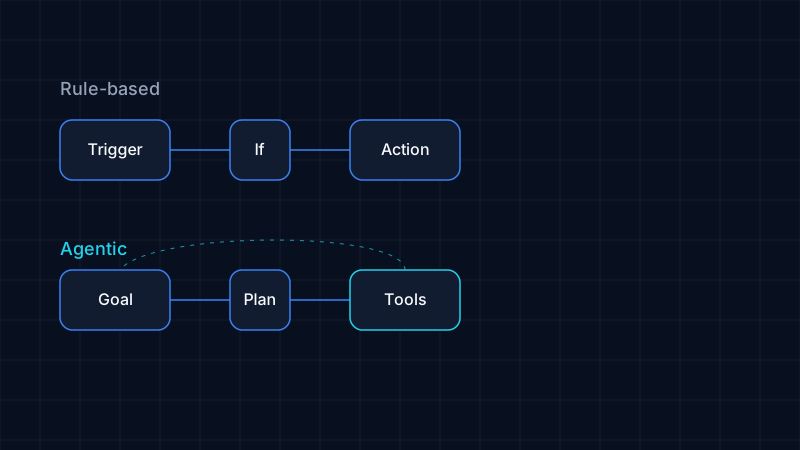
“Should this be an agent?” is often the wrong first question. The better one is: which parts of this process are ambiguous, and which must be exact?
What traditional automation does well
Rule-based automation (scripts, workflow engines, RPA) executes a fixed sequence. It is fast, cheap, and predictable. If your inputs are structured and your rules are stable, it is usually the right answer.
Where it breaks down
- Inputs vary in format, such as free-text emails or scanned PDFs
- The correct action depends on context spread across several systems
- Rules multiply until nobody can maintain them
What an agent adds
An agent pursues a goal by choosing among tools at run time. That flexibility is useful for ambiguous steps, and it costs you determinism, so it must be bounded.
| Dimension | Traditional automation | AI agent |
|---|---|---|
| Control flow | Fixed, defined in advance | Chosen at run time within limits |
| Input handling | Structured or templated | Can interpret unstructured input |
| Predictability | High | Needs evaluation and guardrails |
| Cost per run | Low and stable | Variable (model usage) |
| Debugging | Read the code | Read the trace |
| Best for | Exact, repeatable steps | Ambiguous, context-heavy steps |
The hybrid pattern
Most practical systems put the agent inside a deterministic frame:
async function handleInvoice(doc: Document) {
  const fields = await extractFields(doc);          // agent step: interpret
  const result = validate(fields);                  // deterministic: exact rules
  if (!result.ok) return queueForReview(doc, result); // human step
  return postToLedger(fields);                      // deterministic: write
}
The model interprets the document; ordinary code decides whether the result is acceptable and performs the write.
A short decision guide
- Can you write the rules down completely? Use automation.
- Is the only obstacle unstructured input? Use a model for extraction inside a fixed workflow.
- Does the path itself depend on what is discovered along the way? Consider an agent, with limits and review.
For the engineering detail behind step 3, see Building Production-Ready AI Agents.
Related articles
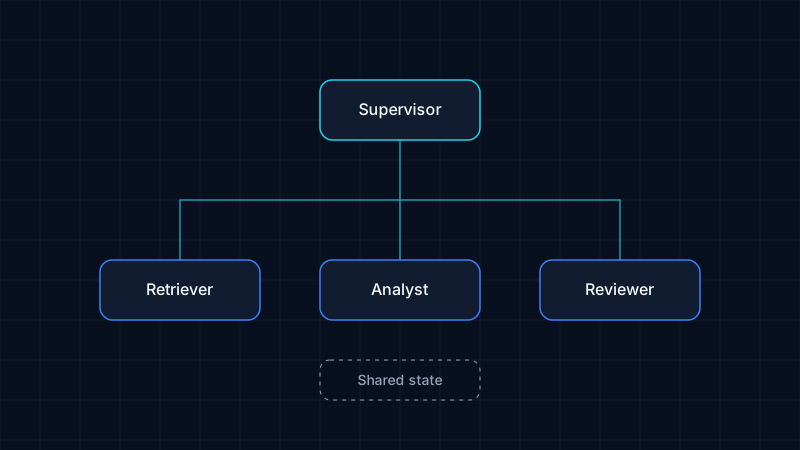
Designing Reliable Multi-Agent Systems
Design principles for systems with several cooperating agents: explicit roles, typed shared state, bounded loops, and traceable hand-offs.
Sample article
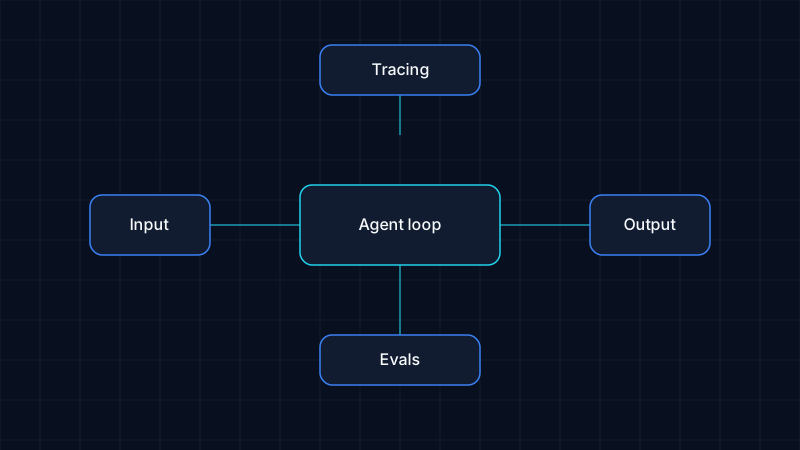
Building Production-Ready AI Agents
A practical checklist for moving an AI agent from a convincing demo to a system you can operate: scope, tools, evaluation, observability, and safe failure.
Sample article