
Designing Reliable Multi-Agent Systems
Design principles for systems with several cooperating agents: explicit roles, typed shared state, bounded loops, and traceable hand-offs.
Sample article. This is illustrative placeholder content. It is not company research, a case study, or a report of customer experience.
Sample article. This is illustrative placeholder content. It is not company research or a report of customer experience.
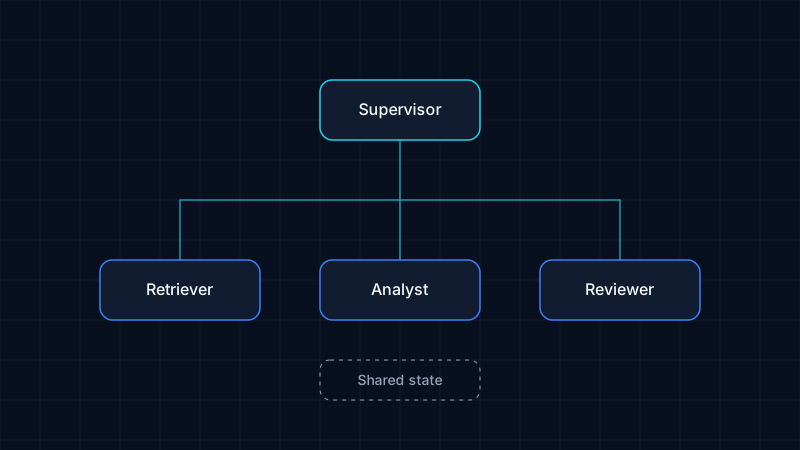
Splitting a task across several agents can make each part simpler to build and test. It also adds coordination problems. Reliability comes from treating the system as a graph with explicit contracts, not as a conversation.
Start with one agent
Add a second agent only when a clear boundary justifies it: different tools, different risk levels, or a prompt that has grown too large to evaluate. Otherwise the extra hand-offs just add failure modes.
Give every agent a contract
Each agent should declare its inputs, outputs, permitted tools, and budget.
from typing import TypedDict

class ReportState(TypedDict):
    question: str
    sources: list[dict]      # written by retriever
    findings: list[str]      # written by analyst
    review_notes: list[str]  # written by reviewer
    status: str              # "drafting" | "needs_human" | "approved"
Share typed state, not free text
Passing structured state between steps makes each hand-off inspectable and testable. Free-text relays tend to lose information and make failures hard to localise.
Bound everything
- Loops: cap iterations between agents such as writer and reviewer
- Budget: limit tokens and tool calls per run
- Time: set deadlines and decide what happens when they pass
Make hand-offs traceable
Record which agent acted, what it saw, what it decided, and why. A trace that spans the whole graph lets you find the step where quality dropped.
| Failure mode | Typical cause | Mitigation |
|---|---|---|
| Endless back-and-forth | No iteration limit | Max rounds, then escalate |
| Lost context | Free-text hand-offs | Typed shared state |
| Over-permissioned agent | One shared credential | Per-agent tool scopes |
| Silent quality drop | No evaluation | Regression suite on the full graph |
Keep a human exit
Give the supervisor an explicit “needs human” outcome and make sure the state needed to resume is checkpointed.
Related reading: Building Production-Ready AI Agents and AI Agents vs Traditional Automation.
Related articles
AI Agents vs Traditional Automation
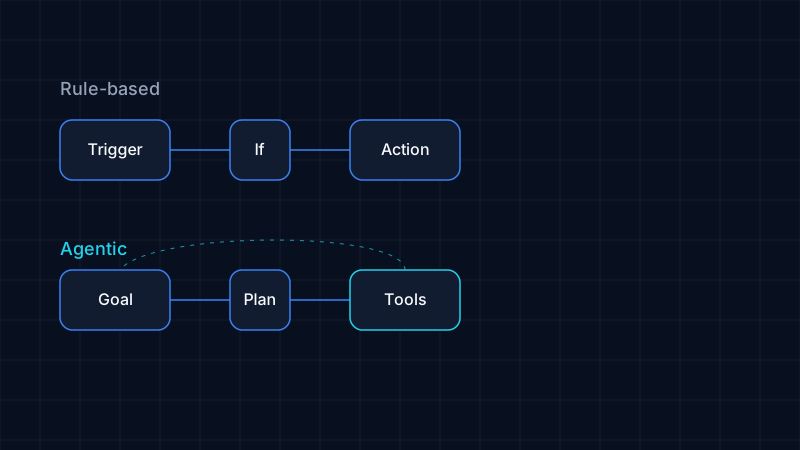
When rules and scripts are the right tool, when an agent earns its added complexity, and why most real systems combine both.
Sample article
Building Production-Ready AI Agents
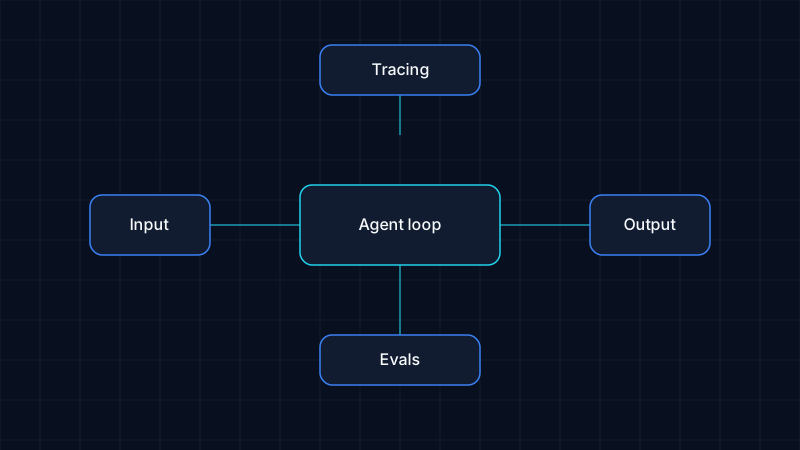
A practical checklist for moving an AI agent from a convincing demo to a system you can operate: scope, tools, evaluation, observability, and safe failure.
Sample article